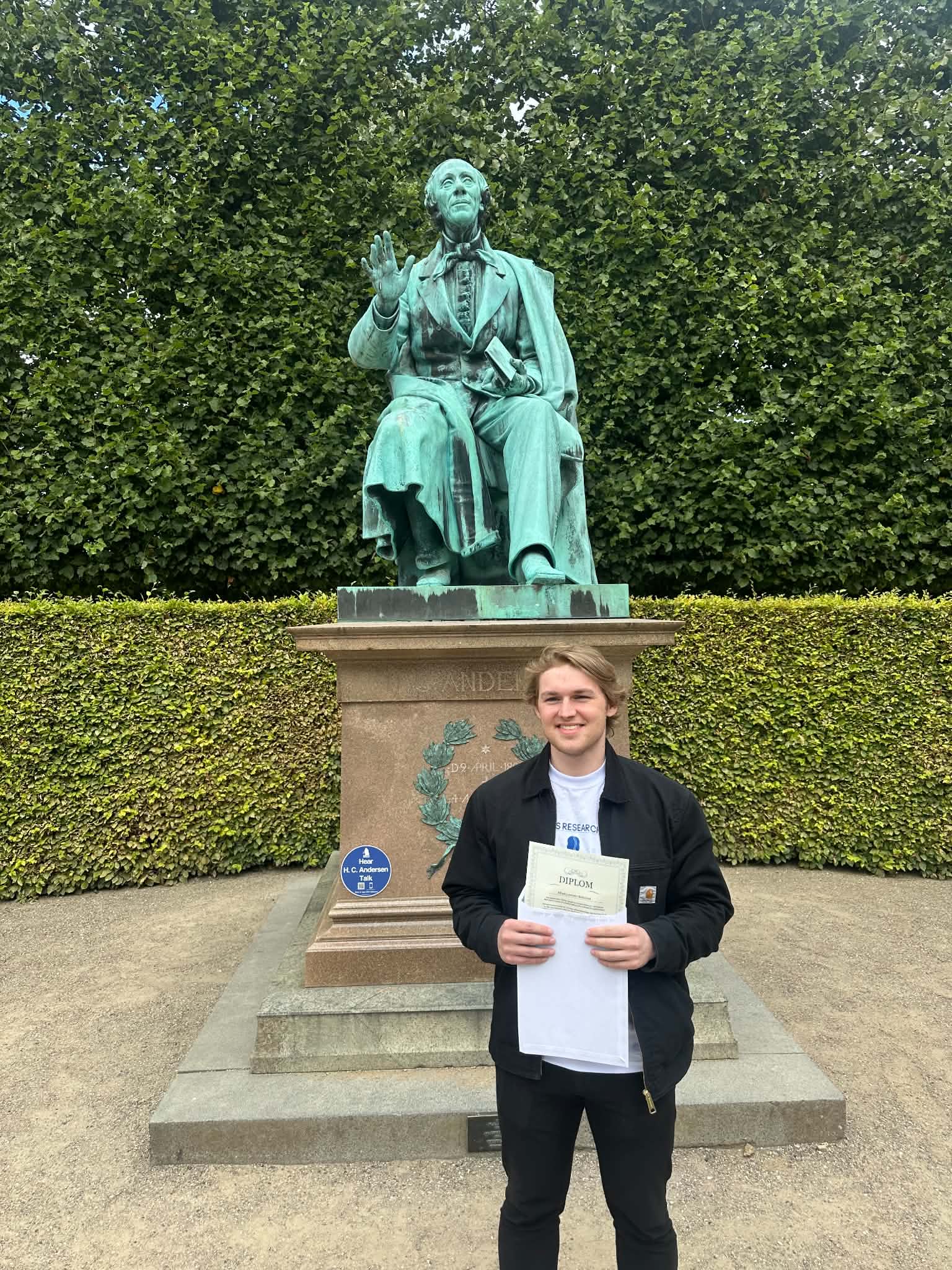
A Breath of Fresh Air
I went to CEPOS Akademi expecting libertarian dogma, a program that would start from a political conclusion and arrange the arguments around it, but I had it wrong. We covered liberalism and conservatism, Danish economic history, Adam Smith’s moral philosophy, Burke and Paine, Popper and Public Choice, and underneath all of it was a question about people more than policy, namely what kind of person a free society needs and what it takes to become one. I was already liberal when I arrived, so the academy did not change my politics, but it put a spotlight on ways of thinking I had never really concerned myself with, and what follows are a few of my thoughts on them.
The first is dannelse, which is easy to mistake for general knowledge or customs. But the way it was used at the academy meant something closer to formation of character, the judgment to use your freedom responsibly and the respect to take other people’s views seriously, even when you disagree with them.
Andreas Paulsen, CEPOS’s head of education, kept returning to the idea of an open agora, a marketplace for ideas where anything may be brought forward as long as the person bringing it is prepared to defend it. I think a society needs that kind of marketplace, but it only works if the people in it respect the agora itself and the other participants, which means arguing with the contents of what a participant actually said rather than spewing ad hominems, and accepting that your own idea may lose. One of our assignments was to write an op-ed, and mine became a piece in Berlingske about Danish politicians and the AI revolution, and having it published meant putting my name to an argument in public and standing behind it.
Thinking about dannelse also gave me a clearer answer to why classical liberalism appeals to me. It offers as much freedom as possible on the condition that you carry the responsibility for what you do with it, and it asks the state for a framework that keeps this fair, with courts that deliver real justice and a market where economic opportunity is open to anyone willing to take it. What it does not ask of the state is to protect people from every difficulty, and I have come to see that restraint as a form of respect, because it treats citizens as adults who can be trusted with their own lives.
Danish has a word for help that does more harm than good, bjørnetjeneste, a bear’s service, after La Fontaine’s fable of the bear who tries to chase a fly off his sleeping master’s face with a stone and kills him. A welfare state can do the same thing with the best intentions. When so much is arranged for you that your own choices stop mattering, the help slowly strips you of your agency, and agency, the sense that what you do makes a difference, is what brings meaning to an otherwise overly cozy life. I don’t want this point to be misinterpreted, because the Danish welfare state has real achievements, and a safety net that catches people when they fall is part of what brings balance to a free society. The moral hazard begins where that net turns into a cushion nobody has a reason to get up from.
The other half is what the freedom is for. We live in a consumption society, where a good life is easily measured by how much you can buy, and where the holiday, the watch or the car is often bought as much to be shown on social media as to be enjoyed. Adam Smith saw the problem long before Instagram. In The Theory of Moral Sentiments he called the disposition “to admire, and almost to worship, the rich and the powerful” the “great and most universal cause of the corruption of our moral sentiments,” and one of his lines could have been written about a holiday feed: “Many a poor man places his glory in being thought rich.” What gives me a sense of purpose points the other way, toward making things, whether that is a company, a piece of research or an essay like this one. Creating is also a plus-sum game, because when you build something people value, the world becomes a little richer without anyone having to lose for it, and you get the satisfaction of having added something rather than only consuming or dwelling in victimhood.
The academy’s distinction between the bourgeois and the civis is where these ideas met for me. The bourgeois works, earns and builds in the economic sphere, the civis takes part in the political community and accepts responsibility beyond his own interests, and the argument was that a free society needs both in the same person. I used to think of dannelse as optional, something you may acquire once the important things are in place, but I now believe it to be foundational. Because a liberal society that gives people as much freedom as possible relies on its citizens to carry it forth. On people who would rather build something than be handed it, and who are willing to stand in the agora and defend what they think. In a culture that mostly asks us to consume and to be looked after, it was a breath of fresh air to spend time in a room that expected us to contribute, to challenge one another, and to take our own ideas seriously. The students were not merely an audience for the excellent guest speakers, but an essential part of the conversation.